
21 Quartz Countertop and Backsplash Ideas for a Stunning Kitchen Combination

You picked the quartz. You love the quartz. But now you’re staring at tile samples and paint chips wondering why nothing looks right next to it. The combination feels off and you can’t figure out why. It’s not a taste problem. It’s a pairing problem.
This list covers 21 quartz countertop and backsplash combinations researched from real homeowner forums, designer breakdowns, and renovation projects across budgets. Each idea was picked because it solves a specific pairing challenge, whether that’s a stark white quartz that needs warmth, a veined slab that already has movement, or a dark countertop that keeps eating the light. Budget ranges from $80 to $450 for the backsplash portion are covered here.
This is for homeowners and renters doing a real kitchen refresh on a real budget, not a gut renovation. If you’re planning a full custom build with unlimited funds, this isn’t your list. But if you want results you’ll actually be happy with, this works.
By the end you’ll know exactly which backsplash pairs with your specific quartz and why it works, so you can move forward without second-guessing every sample.
What to Know Before You Start Quartz Countertop and Backsplash Pairings
- Quartz is non-porous, so grout and caulk compatibility matters more than sealing
- Undertones in quartz shift under different kitchen lighting, always test samples at night too
- Budget reality: a standard 30 sq ft backsplash install runs $200 to $600 in materials alone
- Most people overlook the grout color, which can change the whole look of a tile by 40%
- Common mistake: matching backsplash veining exactly to countertop, it looks busy, vary the scale instead
- Subway tile at 3×6 inches covers about 8 tiles per square foot, useful for quantity estimates
- For long-term durability, porcelain tile outlasts ceramic in kitchen humidity by years
- Peel-and-stick backsplash works on smooth drywall but fails on textured or painted brick surfaces
1. White Quartz with Classic Subway Tile

White quartz and white subway tile sounds boring on paper. In a real kitchen, it reads as clean and polished without trying too hard. The key is that slight difference in finish: the quartz has a smooth matte or gloss surface, while the ceramic subway tile has that slight sheen that catches light differently. That contrast is doing all the work.
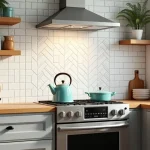
Go with a 3×6 inch white subway in a brick-lay pattern and use a warm gray or greige grout, not white. White grout with white quartz disappears and flattens the whole wall. A warm gray grout like Delorean Gray or Oyster gives you just enough definition. You can tile a 20 sq ft backsplash for around $80 to $120 in materials.
2. Calacatta Quartz with Unlacquered Brass Fixtures and Warm Marble Look Tile
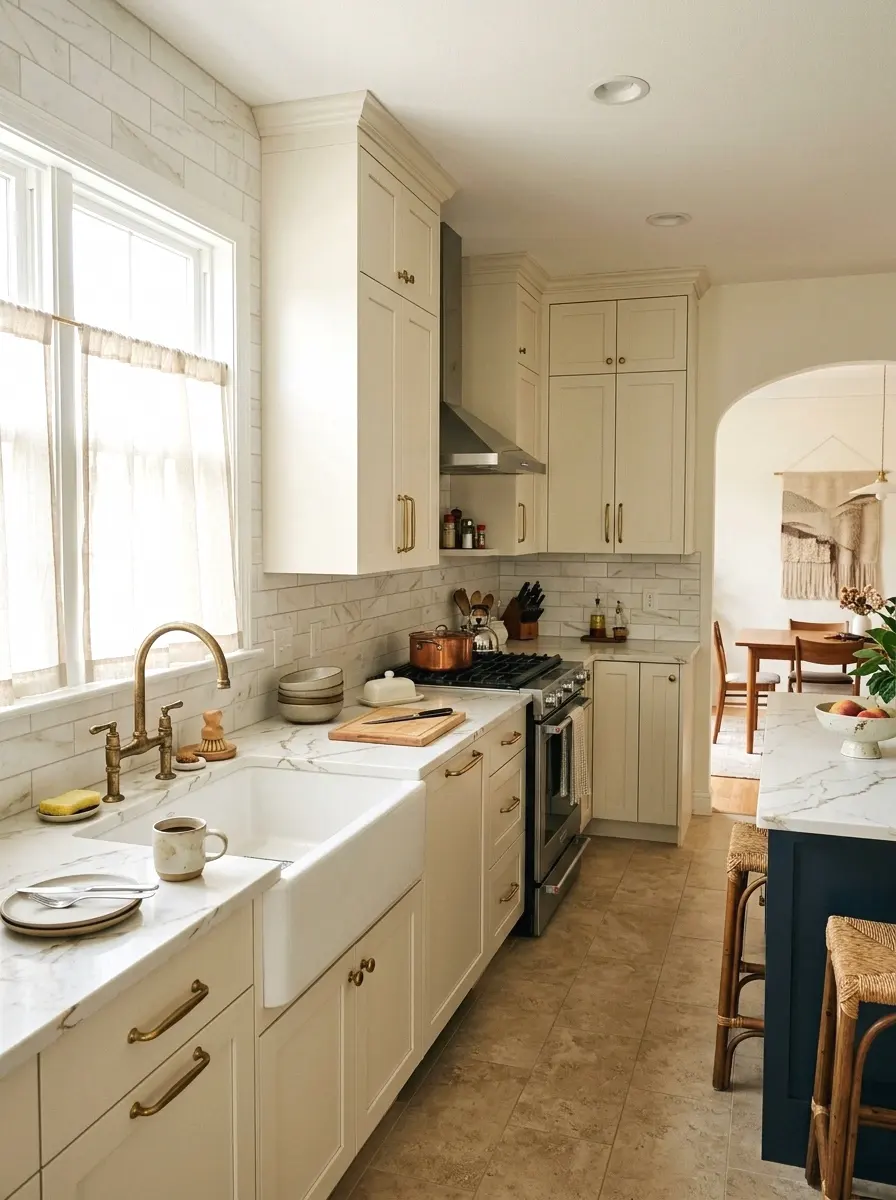
Calacatta quartz has bold gray or gold veining, and it pairs really well with a backsplash that echoes that warmth rather than competing with it. A warm white or cream marble-look porcelain tile at around 4×12 inches keeps the veined look going without adding clutter.
When I tried this combination in a client’s kitchen, the unlacquered brass hardware was what tied it together. The tile cost about $3.50 per square foot and we used roughly 24 square feet. Total material cost came in under $90. The brass fixtures weren’t cheap, but the tile itself was very doable.
More Ideas:


3. Carrara-Look Quartz with Light Gray Stacked Stone

Carrara-style quartz has soft gray veining on a white base. It’s one of the most popular quartz finishes and also one of the easiest to over-complicate with the backsplash. Light gray stacked stone, the kind with a linear ledger panel look, adds texture without adding more pattern.
The trick is to keep the stone panels horizontal. Stacking them vertically makes a small kitchen feel narrower. Horizontal ledger panels run about $8 to $14 per square foot. A typical 24 sq ft backsplash comes in around $200 to $330 in materials. It’s one of the more textured options on this list and honestly one of the most underrated.
4. Jet Black Quartz with White Picket Tile

Dark quartz countertops absorb light and can make a kitchen feel smaller if the backsplash doesn’t do some lifting. White picket tile, also called white elongated hex, bounces light back into the room and the slightly playful shape keeps it from feeling sterile.
Use a white or very light gray grout here. You want the tile to read as a bright, unified surface. The picket shape runs about $4 to $7 per square foot in ceramic. For a 30 sq ft backsplash you’re looking at $120 to $210. It works especially well if your uppers are white or light wood, because everything above the counter stays airy.
If you’re working with white uppers, white cabinet pairing decisions extend beyond the backsplash and are worth thinking through as a whole.
5. Soft Gray Quartz with White Shiplap Backsplash

So here’s the thing about shiplap in a kitchen: it works when it’s done right and looks like a mistake when it isn’t. With soft gray quartz, white painted shiplap reads as farmhouse-clean without getting too themed. The horizontal lines give the room direction and the flat white surface reflects light well.
For anyone leaning into that look, farmhouse kitchen tile styles offer a range of options that pair just as well without the moisture risk.
You need to seal it. Kitchen shiplap has to be primed, painted with semi-gloss, and caulked at every seam or moisture gets in fast. Real wood shiplap runs $1 to $3 per square foot. MDF shiplap is cheaper but swells near the sink. Keep it away from any area that gets regular splash and you’re fine.
6. Veined Quartz with Plain Zellige-Style Tile

Zellige-style tile, those slightly irregular handmade-looking Moroccan squares, adds texture and warmth that flat tiles can’t. With a heavily veined quartz, you don’t want a backsplash that also has a lot of pattern. Plain zellige in an off-white, cream, or warm putty color gives you texture without adding another visual layer.
The variation in each tile’s surface catches light differently throughout the day, which is what makes it interesting. Zellige-style ceramic runs about $6 to $12 per square foot. A 20 sq ft install comes in around $120 to $240. It’s a step up from subway in feel but not in price.
More Ideas:
7. Cream Quartz with Terracotta Hex Tile

Cream quartz sits in that warm neutral zone and terracotta hex tile pushes it even warmer. It’s a combination that photographs really well and also looks great in person, which isn’t always true of kitchen combos. The earthy orange-red of terracotta grounds the lightness of the cream quartz without making things too heavy.
Use a cream or sand grout to keep the pattern visible without making it too bold. Terracotta porcelain hex tile runs about $5 to $9 per square foot. You can do a 20 sq ft backsplash for $100 to $180 in materials. I was skeptical about this one but it consistently gets the best reactions from people who see it in person.
If the terracotta direction appeals to you, there are more warm-toned backsplash options worth seeing before you finalize your material.
8. Greige Quartz with Long Thin Brick Tile

Greige quartz (gray with beige undertones) is one of the most versatile countertop finishes because it reads warm in some lights and cool in others. Long thin brick tile, also called a metro brick or slim brick at 2×8 or 2×10 inches, gives you a clean linear pattern that doesn’t pull the eye away from the counter.
Lay it in a running bond pattern and use a greige or taupe grout that matches the quartz undertone. The thin format makes the wall feel taller without any visual noise. Slim brick ceramic runs $2.50 to $5 per square foot. It’s one of the most affordable options on this list with one of the most polished results.
9. White Quartz with Sage Green Zellige Tile

This is the combination that started appearing on renovation accounts in 2024 and for good reason. Sage green zellige behind white quartz brings in color without committing to a full kitchen paint change. The slightly irregular surface of the zellige keeps it from looking too matchy or catalog-perfect.
Go for a muted sage, not a bright green. You want it to read as a neutral with a green tint, not a statement color. True zellige from Moroccan sources runs $18 to $30 per square foot. Zellige-inspired ceramic copies run $7 to $12. For most kitchens the ceramic version is the smarter call unless you’re going all the way with the design.
10. Quartz with Bold Veining and Plain White Large Format Tile

When the countertop already has a lot going on visually, the backsplash should quiet down. A large format white tile at 12×24 or 18×36 inches does exactly that. Fewer grout lines mean less visual complexity, and the flat white surface lets the quartz veining be the main event.
Keep the large tiles in a stacked or offset pattern depending on your wall dimensions. Fewer cuts make install easier and waste less material. Large format white porcelain runs $3 to $7 per square foot. For a 30 sq ft backsplash you’re looking at $90 to $210 in materials, which is pretty reasonable for the impact.
More Ideas:
11. Blue-Gray Quartz with White Herringbone Tile

Blue-gray quartz has cool undertones that work really well with the clean geometry of white herringbone tile. The pattern adds movement to the wall without adding color, so the counter stays the focus. It’s a combination that reads as slightly more designed than plain subway but isn’t complicated to execute.
Blue-gray quartz also shows up a lot in coastal kitchen tile combinations if you want to see how that palette plays out across a full room.
Use a 2×4 or 2×6 white ceramic in a herringbone layout. The install takes longer than straight tile because of the angled cuts, but the tile itself is inexpensive. White ceramic in herringbone runs about $3 to $6 per square foot. Budget around $90 to $180 for a 30 sq ft backsplash. Use a light warm white grout, not a stark white, to soften the geometry.
12. Dark Veined Quartz with Fluted White Ceramic

Fluted tile, the kind with vertical ridges pressed into the face, is one of the better-looking trends that’s actually practical. Behind dark veined quartz it adds dimension and light-catching texture that makes the whole wall feel more intentional. It’s simple but looks expensive.
The ridges on fluted tile create small shadows throughout the day, which means the backsplash actually shifts in feel as light changes. Fluted white ceramic runs $8 to $15 per square foot. It’s pricier than plain subway but you typically need less of it because the texture does the work. A 20 sq ft install runs $160 to $300 in materials.
13. Concrete-Look Quartz with Raw Cement Tile

Concrete-look quartz has a flat, slightly mottled gray surface that pairs well with an actual cement tile backsplash. The two textures are different enough to keep things interesting but close enough in tone to feel like a deliberate choice. It reads as very modern and minimal.
If that modern minimal kitchen design direction is where you’re headed, there’s a full breakdown of how white quartz anchors that aesthetic from counter to cabinet.
Cement tiles are porous and need sealing before and after grout is applied. That’s an extra step but not a difficult one. Plain gray cement tile runs $8 to $16 per square foot. For a 25 sq ft backsplash you’re looking at $200 to $400 in materials. It’s on the higher end but the finish is genuinely distinct from anything ceramic.
14. Warm White Quartz with Penny Round Mosaic

Penny round tile, those small circles about 3/4 to 1 inch in diameter, adds visual texture at the wall scale without being a bold pattern choice. With warm white quartz, using a cream or soft blush penny round keeps the warmth going from counter to wall in a way that feels considered.
(This one took me ages to figure out, but the circle shape is what makes it work with rounded or curved countertop edges. Square tile near a curved edge looks awkward.) Penny round mosaic sheets run $6 to $14 per square foot. A 20 sq ft backsplash comes in at $120 to $280, which is reasonable for the amount of detail you’re getting.
More Ideas:
15. Black and White Quartz with Unlacquered Brick

Some quartz slabs have a graphic black and white pattern, almost like a newspaper or terrazzo print. The worst thing to put behind it is another pattern. Raw or tumbled brick tile in a warm buff or light tan color grounds the graphic quartz and gives the eye a place to rest.
The brick texture reads as natural and slightly rough which contrasts well with the polished or honed quartz surface. Thin brick veneer tile runs $4 to $9 per square foot. For a 30 sq ft backsplash you’re spending $120 to $270. Make sure you use a matching mortar-colored grout so the brick reads as whole rather than cut into pieces.
16. Quartz with Gold Veining and Warm Travertine-Look Tile

Quartz with gold or amber veining leans into a warmer palette that needs a backsplash to match. Travertine-look porcelain tile in beige or warm ivory picks up those gold tones without looking too matchy. The slightly worn, natural appearance of travertine-style tile gives the kitchen depth.
Real travertine is porous and harder to maintain in kitchens. Travertine-look porcelain gives you the same visual with none of the upkeep. It runs $4 to $8 per square foot. A 24 sq ft backsplash costs $96 to $192 in materials. It’s one of the warmest-looking combinations on this list and works really well in kitchens with wood or brass accents.
For quartz paired with warm wood accents, a sage green and wood kitchen shows exactly how that layering works without tipping into too much.
17. Soft Lavender-Tinted Quartz with White and Gray Geometric Tile

Some newer quartz finishes have a faint purple or lavender undertone that most people don’t notice until they put a warm beige tile next to it and suddenly everything looks yellow. White and gray geometric tile, like a simple hexagon or diamond shape, keeps the undertones neutral so the quartz reads correctly.
Stick to a white base tile with gray pattern, not a beige or ivory, for this combination. The gray in the pattern should match the gray veining in the quartz. Geometric porcelain mosaic runs $7 to $13 per square foot. For 20 sq ft you’re spending $140 to $260. It’s one of the more design-forward options and works well in kitchens with clean modern lines.
18. Thick Waterfall Quartz Island with Matching Slab Backsplash

When you have a quartz island with a waterfall edge, tiling the backsplash behind it with a contrasting material creates a visual disconnect. Continuing the same quartz up the wall as a slab backsplash keeps everything seamless, which is the whole point of a waterfall design.
This does require fabrication, which means extra cost. Most fabricators charge $40 to $80 per square foot for the slab backsplash portion, separate from countertop pricing. For a 15 sq ft backsplash that’s $600 to $1,200. It’s the most expensive option here but for a waterfall island it’s the right call. Tile behind it looks like a budget compromise.
More Ideas:
19. White Quartz with Dark Navy or Charcoal Backsplash Tile

The reverse of the typical light backsplash behind light counter, a dark backsplash behind white quartz creates serious contrast. It makes white quartz look brighter and more substantial and the overall kitchen feels more dramatic without any structural changes.
Use a matte or satin finish on the dark tile, not glossy. Glossy dark tile shows every water spot and fingerprint. Navy or charcoal matte subway tile runs $3 to $7 per square foot. A 30 sq ft backsplash costs $90 to $210. Make sure your cabinetry has some lightness to it because dark tile plus dark cabinets plus dark anything else gets heavy fast.
20. Quartz with Wood-Look Veining and Rattan or Cane Panel Accent

Some quartz finishes have a linear brown and cream pattern that almost reads as wood grain. Pairing it with a cane or rattan panel section on the backsplash (even just one panel behind the range) adds a natural material that echoes the wood feel.
Cane panels aren’t traditional tile but they’re being used more in dry backsplash areas away from the sink and range. They need to be sealed and kept away from heavy steam or water splash. Pre-made cane panels run $40 to $120 per panel depending on size. It’s not for every kitchen but in a warm or Japandi-inspired space it works really well.
If you’re open to skipping tile altogether, there’s a solid collection of backsplash ideas without traditional tile that covers more of these alternative approaches.
21. Gray Quartz with Bold Handpainted Talavera Tile Accent

You don’t have to tile the entire backsplash in one material. A gray quartz with a clean white subway field tile works well everywhere, except you add a row or panel of bold hand-painted Talavera tile as a feature strip behind the range. It adds personality without committing the whole kitchen to one loud choice.
Keep the Talavera strip to a single row or a 12 to 18 inch wide panel. One panel of real Talavera behind the range costs $60 to $150 depending on the size and source. The rest of the backsplash stays in inexpensive subway at $80 to $120. Total backsplash cost stays reasonable and the result looks like something you planned rather than something you found on sale.
Final Thoughts on Quartz Countertop and Backsplash Ideas
You now have 21 real, specific combinations with real costs attached. The through line across most of them is the same: let one thing lead. If the quartz has movement, let it. Give the backsplash a simpler job. If the quartz is plain, the backsplash gets to do more. That’s the logic that makes a pairing work rather than compete.
Start with your countertop’s undertone. Pull a sample of the tile you like and hold it next to the actual quartz in your kitchen light, not a showroom, not a phone screen. That one step will save you from most of the returns and regrets people run into.
Understanding how lighting affects countertop color reads also matters when you’re choosing wall color around the whole setup, not just the backsplash.
If you want more ideas like this broken down by room, budget, and real product types, homelypop.com covers a lot of this territory in the same no-guesswork way.