

20 Apartment Decor for Remote Workers With ADHD Who Need a Distraction-Free Setup

Your brain keeps pulling you toward the pile of dishes, the buzzing phone, and the TV you swore you’d ignore. Working from home with ADHD isn’t just hard. It’s a daily battle against your own environment.
These 21 apartment decor ideas were pulled from real ADHD remote worker communities, neurodivergent design research, and actual product testing. Each one targets a specific focus problem, whether that’s visual clutter, noise, movement, or time blindness. The budget range runs from $100 to $700, and every pick can work inside a small apartment without a dedicated home office.
This guide is for renters and apartment dwellers on a real budget who want a workspace that actually helps their brain stay on task. If you’re looking for a full-scale office renovation with custom built-ins, this isn’t that. But if you want changes that make a measurable difference, you’re in the right place.
By the end, you’ll have a clear picture of exactly what to add, swap, or remove to build a focus environment that works with your ADHD brain, not against it.
What to Know Before You Start ADHD Apartment Decor for Remote Workers
- ADHD brains need the right stimulation, not zero stimulation. Sterile spaces can make focus worse.
- Visual clutter is not just messy. For ADHD, it actively pulls attention away from the task in front of you.
- Budget reality: a functional ADHD-friendly setup can be built for $200–$400 without sacrificing quality.
- Closed storage beats open shelving. What your eyes can’t see, your brain won’t chase.
- Most people forget lighting. Harsh overhead fluorescents are a focus killer for ADHD adults.
- Positioning matters. A desk facing a wall beats a desk facing the room for most ADHD remote workers.
- Long-term tip: choose furniture with easy “reset” routines in mind, not what looks good on day one.
- Renters: command strips, tension rods, and freestanding units keep your deposit safe while still transforming the space.
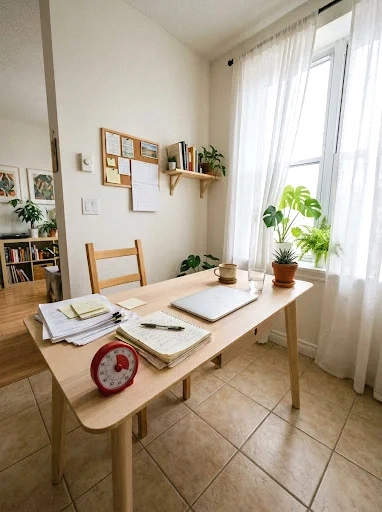
1. A Dedicated Desk Facing a Wall, Not the Room
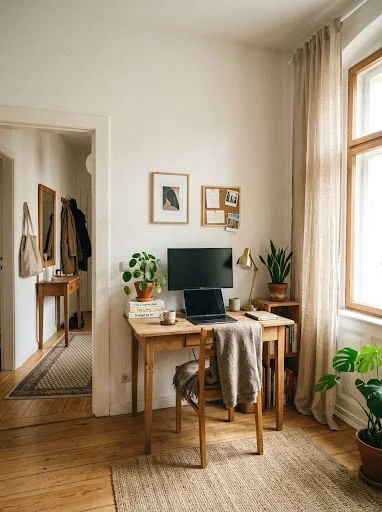
The single biggest setup mistake I see ADHD remote workers make is putting their desk in the middle of the room or facing outward toward foot traffic. When your desk faces a blank wall, your brain has nowhere to wander visually. That one shift alone can cut random distraction by a surprising amount. You’re giving your eyes a boundary, which means your attention gets one too. I moved my own desk to face the wall about two years ago and couldn’t believe how much calmer my sessions felt.
A basic IKEA LINNMON desk runs about $60–$80 and fits in tight apartment corners. If you have a little more room in the budget, the IKEA MICKE desk at around $130 adds a drawer for cable and supply storage. Position it so the wall is 12 to 18 inches from your face. Not so close it feels like a box, but close enough that a glance up hits drywall, not a pile of laundry across the room.
If you’re still figuring out where your desk fits best in the room, there are some solid desk placement and layout ideas worth browsing before you commit.
2. Blackout Curtain Panel Behind the Desk
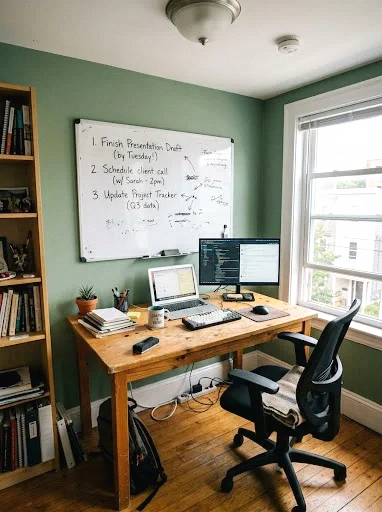
If your desk is near a window, that window is working against you. Passing clouds, people walking by, birds, movement of any kind pulls ADHD eyes away mid-sentence. A single blackout panel behind or beside your desk blocks that pull without making the whole room dark. You’re not closing off natural light for the rest of the apartment. You’re just protecting your work zone.
You can find blackout curtain panels at Target or Amazon for $25–$40 each. Stick with neutral tones like charcoal, warm white, or sage green so the panel doesn’t become its own visual distraction. Hang it with a basic tension rod if you want a no-drill, deposit-safe solution. The rod fits inside the window frame, holds the panel, and comes down in five minutes when you move out.
3. A Large Magnetic Whiteboard on the Wall
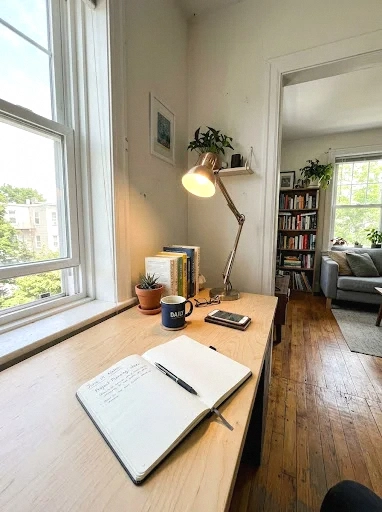
Here’s what nobody tells you about ADHD and task management: digital to-do apps are terrible for most ADHD brains because you can’t see them unless you switch to that tab. A whiteboard changes that. Tasks live in your physical field of vision, which means they actually trigger action instead of getting buried under seventeen other tabs.
Go big. A 36-by-24-inch whiteboard runs about $35–$55 on Amazon. Anything smaller and your brain starts to treat it like background noise. Mount it at eye level directly above or beside your desk. Use it for three things only: today’s top tasks, one time block, and one current project. Nothing else. The moment you start adding old reminders and phone numbers, it stops working. Wipe it clean every morning. That reset matters.
4. Warm LED Desk Lamp With Dimmer
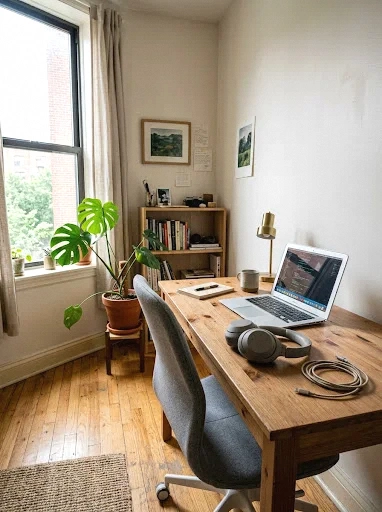
Overhead lighting in most apartments is flat, harsh, and designed for kitchens, not focus work. For ADHD adults, that cold overhead light creates a kind of sensory buzz that sits in the background all day. Swapping it out completely isn’t always possible in a rental. But adding a warm LED desk lamp with a dimmer control is. It gives you a focused light source right at your workspace, which signals your brain that this area is for work.
The BenQ ScreenBar runs around $109 and sits on top of your monitor, so it doesn’t eat desk space. If that’s over budget, the TaoTronics LED desk lamp with dimmer is about $35 at Amazon and has five brightness levels. Go for a color temperature between 3000K and 4000K. That’s the warm-to-neutral range that keeps you alert without the eye strain that makes ADHD symptoms worse halfway through the afternoon.
If you want to go further than just a desk lamp, there are full lighting setup ideas for home offices that cover overhead, task, and ambient options together.
5. Noise-Cancelling Headphones for Sound Control
Random noise is one of the fastest ways to blow up focus for an ADHD brain. A neighbor’s TV. A dog down the hall. A delivery buzzer. Each unexpected sound triggers a full attention reset. Noise-cancelling headphones don’t just mute sound. They remove the unpredictability of sound, which is the part your ADHD brain actually reacts to.
The Sony WH-1000XM5 headphones are around $280–$350 at Best Buy or Amazon. If that’s too much right now, the Anker Soundcore Q45 is about $55 and works well for blocking low-frequency background hum. Either way, this is one of the highest-return purchases in a distraction-free setup. Some ADHD remote workers pair headphones with brown noise or lo-fi music playing at low volume. The constant predictable sound keeps the brain mildly stimulated without competing with work. I was skeptical about brown noise for years, but it genuinely works for low-stimulation tasks like emails and data entry.
6. A Time Timer Visual Clock
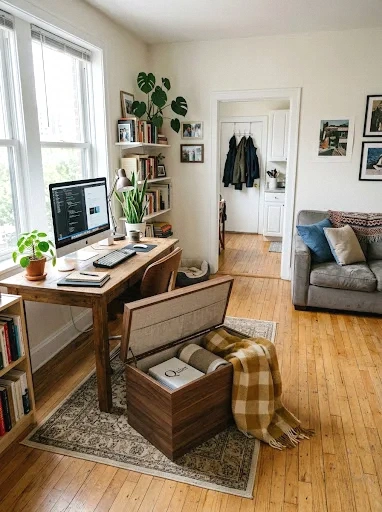
Time blindness is a real and underrated ADHD challenge. When you can’t feel time passing, you either hyperfocus for four hours without a break or drift into distraction without noticing. A visual timer fixes this by showing you, in a physical shrinking red disk, exactly how much time is left in a work block. It makes time visible the same way a whiteboard makes tasks visible.
The original Time Timer comes in 8-inch and 12-inch versions, priced at $35–$45 at Walmart or Amazon. Place it at the edge of your desk where it’s visible without being directly in your line of sight. Set 25-minute work blocks with 5-minute breaks, or whatever interval your brain runs best on. The physical nature of it, an actual object on your desk that you can see changing, works far better than a phone timer that you can dismiss and forget about in three seconds.
7. Closed Storage Ottoman or Bench
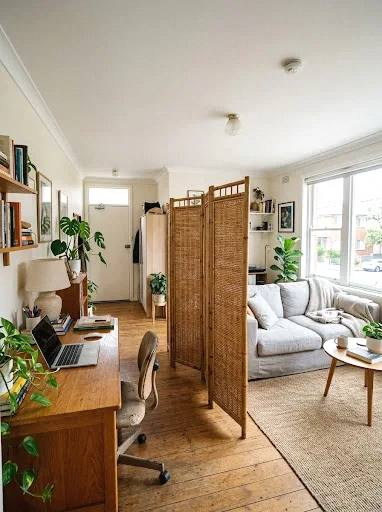
Open shelves in an apartment are a focus tax for ADHD brains. Every item on display is a visual input that competes for attention. A storage ottoman or closed bench near your desk lets you sweep everything into one container at the end of the day without hunting for a spot for each item. Out of sight genuinely means out of mind for most ADHD adults.
The IKEA TJUSIG bench with storage runs about $60–$80 and fits underneath a console table or along a wall. If you want something with a padded top that doubles as seating, check Wayfair or Amazon for storage ottomans in the $70–$130 range. Go for one with a hinged lid and solid sides. Open-weave baskets still let your brain see the mess inside. Solid panels block it completely, which is the point.
If the ottoman alone isn’t enough, there are more storage solutions for tight apartment spaces that work just as well without taking up extra floor room.
8. A Freestanding Room Divider or Bookshelf Partition
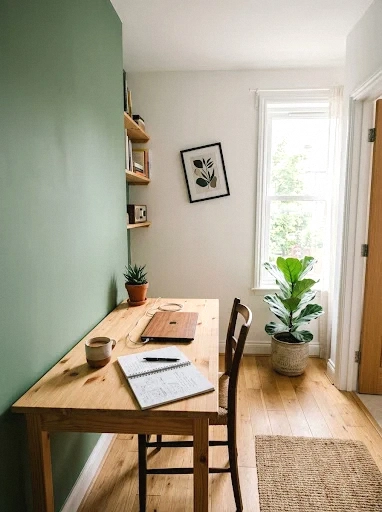
In a studio or one-bedroom apartment, the kitchen, living room, and workspace often share the same air. That’s a focus problem because your brain is surrounded by rest-zone cues while you’re trying to do deep work. A freestanding room divider or tall bookshelf used as a partition creates a physical boundary without permanent changes to the apartment.
A 5-panel folding divider from Amazon or Target runs $60–$120 depending on material. Bamboo or fabric panels look clean and don’t add visual weight. For a more practical version, a 6-foot tall IKEA KALLAX shelf ($130–$160) placed perpendicular to the wall acts as a partition and adds closed storage at the same time. Face the open cubbies away from your desk. Put fabric cube inserts in the side that faces you so you’re looking at a flat surface, not a grid of stuff.
9. A Blue or Green Accent Wall Behind the Desk
Color has a real neurological effect on focus. Blues and greens calm the nervous system and reduce the sensory restlessness that makes it hard to stay in a chair for more than twelve minutes. You don’t need to repaint the whole apartment. One wall directly behind or beside your desk is enough.
For renters, Tempera peel-and-stick paint panels and removable wallpaper from companies like NuWallpaper or RoomMates run $40–$80 for a single accent wall. A soft slate blue or sage green works best. Stay away from dark navy or forest green at close range because those absorb too much light and can feel heavy for people already dealing with low dopamine. The effect is subtle, but subtle is actually the goal here. You want a visual environment that keeps the brain calm enough to focus, not one that excites or overwhelms it.
If you want to see how different tones actually land on a real wall before committing, checking out accent wall color options that work in small spaces helps narrow it down fast.
10. Under-Desk Cable Management Tray
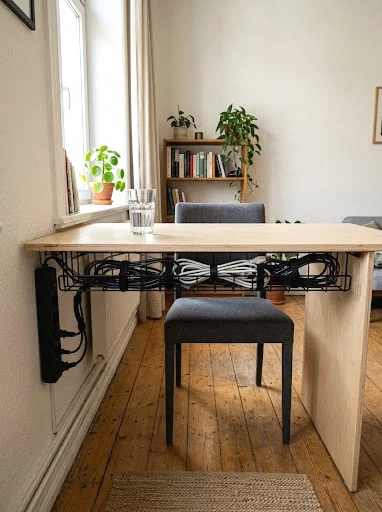
Visible cable clutter is the kind of background stress that ADHD brains register constantly without you realizing it. Cords snaking across the floor or hanging off the desk edge create visual noise. A basic under-desk cable management tray screws or clamps to the underside of your desk and holds power strips, charger cables, and adapter bricks out of sight.
Cable management trays from Amazon or The Container Store run $15–$30. The J-channel adhesive version works great on IKEA desks and leaves no permanent marks. Pair it with velcro cable ties at $8 for a pack of 25 to bundle your monitor cable, laptop charger, and keyboard wire into a single clean run. Took me ages to figure this out, but the five minutes it takes to set up cable management genuinely changes how the desk area feels. Clean surfaces = calmer brain. It’s that direct.
There are also some broader ways to keep your desk surface clear that go beyond cables, and they make a real difference for an ADHD workspace.
11. An Adjustable Standing Desk or Desk Converter
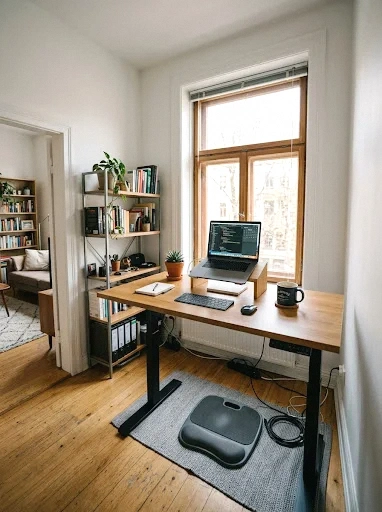
Movement is not a distraction for ADHD brains. It’s fuel. Research from a 2015 study showed that people with ADHD performed better on memory and focus tasks when they were allowed to move. A sit-stand desk lets you shift positions throughout the day, which keeps the proprioceptive system engaged enough that your brain doesn’t go hunting for stimulation elsewhere.
A basic FlexiSpot electric standing desk starts around $230–$280 at Amazon. A full standing desk might be over budget for some setups, so a desk converter is a solid middle option. The Flexispot M2B converter sits on top of your existing desk and lifts the monitor and keyboard to standing height. It runs about $130 at Amazon. Even alternating between sitting and standing every 45 minutes makes a measurable difference in afternoon focus for most ADHD remote workers.
12. Scent Diffuser With Focus-Supporting Oils
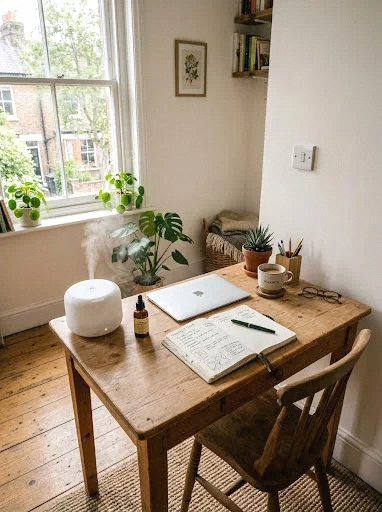
Scent is an underrated sensory tool for ADHD regulation. Peppermint and rosemary have both been studied for their effect on alertness and working memory. They don’t replace other focus strategies, but a scent diffuser running in the background adds a consistent sensory anchor to your work zone. Over time, your brain starts to associate the scent with work mode the same way it associates sitting down with eating.
An ultrasonic diffuser from Amazon runs $20–$35. Add a bottle of peppermint essential oil at $8–$12 and you’ve got a long-term focus tool for under $50 total. Run it during work hours only. That specificity is what builds the association. Don’t run it while watching TV or cooking. Save it for your desk sessions. Peppermint is sharp and energizing. Rosemary is a bit softer. Most ADHD remote workers find peppermint works better for morning deep work and rosemary for afternoon email sessions.
13. A Pegboard Wall Panel for Visual Organization
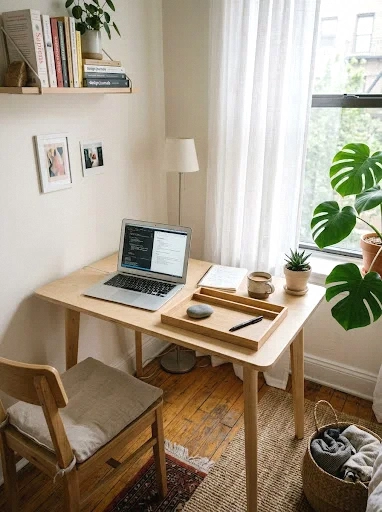
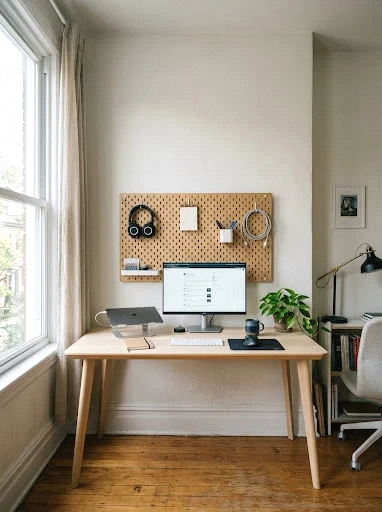
Open shelves create chaos. Pegboards create controlled visibility. The difference is that pegboards let you see your most-used tools without them spreading across your desk or disappearing into drawers. For ADHD brains, items that are out of sight get forgotten. Items that are visible but organized stay useful without becoming visual clutter.
IKEA’s SKADIS pegboard system starts at $15 for the small board and goes up to $35 for the large version. Add hooks, shelves, and containers from the same line at $3–$10 each. Mount it above or beside your desk. Put your headphones, one notepad, two pens, and your charging cable on it. That’s it. The moment it becomes a storage wall for everything you own, it stops working as a focus tool and starts working against you.
14. A Fidget Tool Drawer or Tray on the Desk
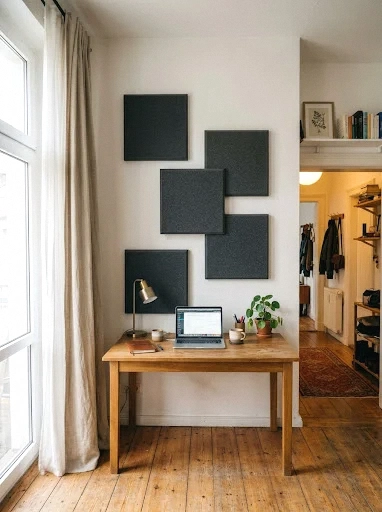
Fidgeting is not a bad habit for ADHD adults. It’s often necessary. Physical micro-movement keeps the brain stimulated enough to stay in a task without fully breaking focus. The problem is when the fidget tool becomes its own distraction, which happens when it’s not contained. A small tray or single shallow drawer on the desk gives fidget tools a home where they’re accessible but not in the way.
A wooden desk organizer tray from Amazon or Target runs $12–$25. Keep two or three tools in it: a smooth stone, a quiet click pen, a silicone ring. Stay away from anything that makes noise. The Speks magnetic desk toy ($25 at Speks.com) is a good option because it’s compact, quiet, and can be used with one hand while reading. The point is to give your hands something to do so your brain can stay on the screen in front of it.
15. Acoustic Panels or Thick Curtains for Sound Dampening
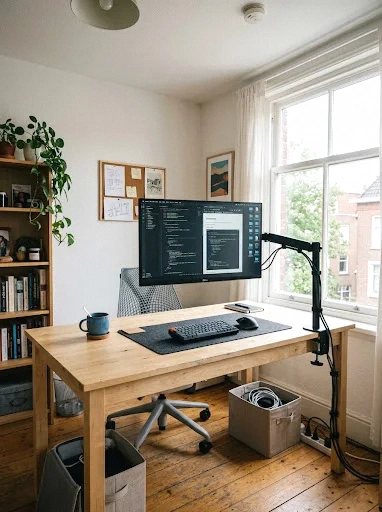
Hard-surface apartments amplify every sound. Footsteps, dishes, a phone call from the next room, all of it bounces around and lands in your ears while you’re trying to stay in a meeting or finish a paragraph. Acoustic panels absorb that bounce. They’re primarily a sound treatment tool, but they also add a soft textural layer to walls that makes the space feel less sharp and clinical.
Acoustic foam panels from Amazon run $25–$60 for a 12-panel set and go up on walls with removable adhesive strips. A more stylish option is thick velvet or wool curtains hung on a floor-to-ceiling track. Curtains at IKEA or Target in heavy fabric run $40–$90 per panel. Either solution works. The curtain version does double duty as a room divider and sound dampener, which makes it a better investment for apartment spaces where every item needs to earn its place.
16. A Monitor Arm to Free Up Desk Space
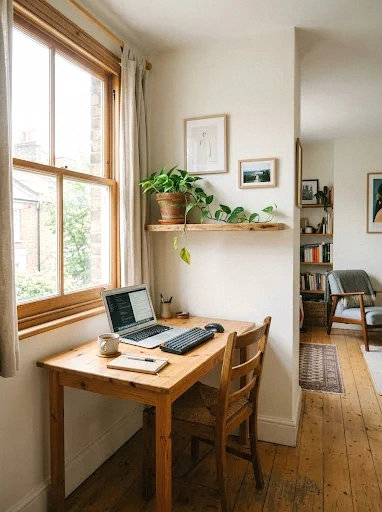
Desk real estate is precious in an apartment, and a monitor stand that sits on the desk surface eats about 10 inches of usable space. A monitor arm clamps to the edge of the desk and holds the monitor in the air, giving you the full desk surface back. More importantly, it lets you push the monitor further back, which reduces eye strain and gives you a full arm’s length of clear space between you and the screen.
A basic Amazon Basics monitor arm runs about $25–$35 and fits most 27-inch monitors. The Ergotron LX arm at $50–$60 has better cable routing and a smoother tilt mechanism. Both are available on Amazon. Combine this with a laptop stand and a separate keyboard and you’ve got a proper ergonomic setup that keeps your neck and shoulders in a position that isn’t working against your already-tired ADHD brain by 3 PM.
17. A Small Indoor Plant at Desk Level
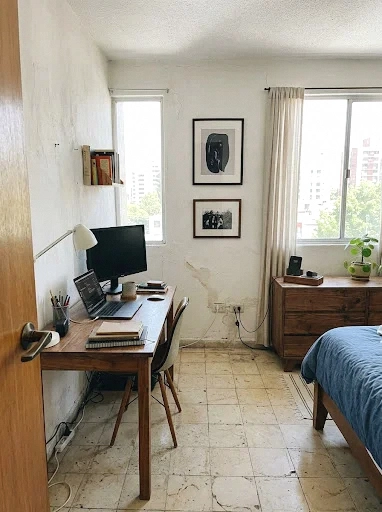
Plants are not just nice to look at. For ADHD remote workers, a single small plant at desk level provides a gentle, organic visual anchor that gives your eyes somewhere to rest during micro-breaks without pulling your attention completely away from work. Looking at greenery, even briefly, reduces mental fatigue. That’s not interior design advice. That’s a well-studied effect called attention restoration theory.
A pothos or snake plant from Home Depot or a local nursery runs $8–$20. Both are nearly impossible to kill and don’t need much sunlight. Put it at the far corner of your desk or on a small shelf at eye level beside it. Don’t put it directly in front of your monitor, where it becomes a foreground distraction. Just off to the side, where it sits in your peripheral vision and gives your eyes a soft organic texture to land on during breaks.
18. A Dedicated Charging Station Away From the Desk
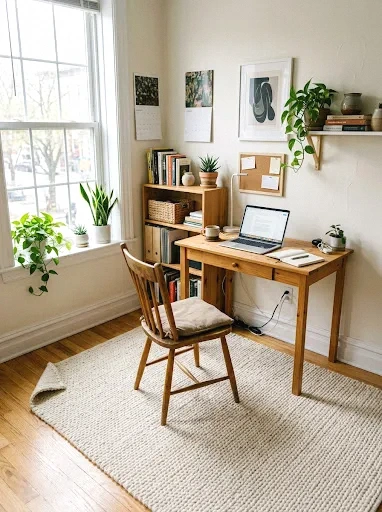
The phone is the number one distraction tool in any remote worker’s apartment, but for ADHD adults it’s especially brutal because the pull to check it is almost physical. Moving your charging station to a different surface, across the room or outside the workspace entirely, creates a small but real barrier between you and the phone during work blocks.
A simple wooden charging station from Target or Amazon runs $25–$50 and holds your phone, earbuds, and watch in one spot. Plug it in across the room, not at your desk. The extra 10 steps it takes to go get your phone is enough friction to break the automatic grab reflex on most days. This one change costs almost nothing relative to its focus impact. Pair it with your Time Timer from item 6 and you’ve built a physical system that makes staying on task easier than breaking it.
19. Warm Rug Under the Desk Area
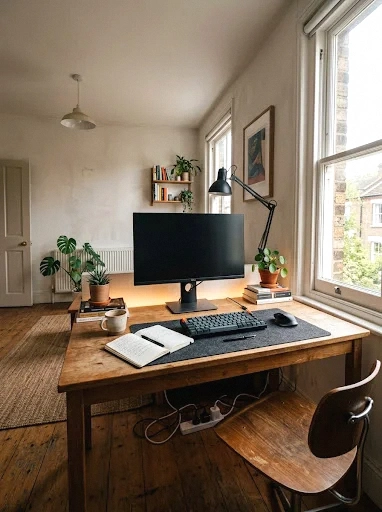
Hard floors create a cold, sterile sensory environment that doesn’t do any favors for ADHD focus or comfort. A rug under and around your desk area adds texture and warmth that makes the space feel defined and grounded. It also reduces echo in the room, which ties back to the sound dampening from item 15. And it gives your feet a soft surface to rest on, which matters more than it sounds when you’re sitting for hours.
A wool or jute area rug from Wayfair or IKEA in a 5-by-7-foot size runs $60–$150 depending on material. Wool is best for natural texture and durability. Jute is cheaper but rougher underfoot. Stick to a solid color or a very simple pattern. Busy rugs with complex repeating patterns become another visual input your brain has to process. Go for cream, warm gray, or terracotta for a neutral base that doesn’t compete with your focus zone.
20. A Simple Task Lighting Strip Behind the Monitor
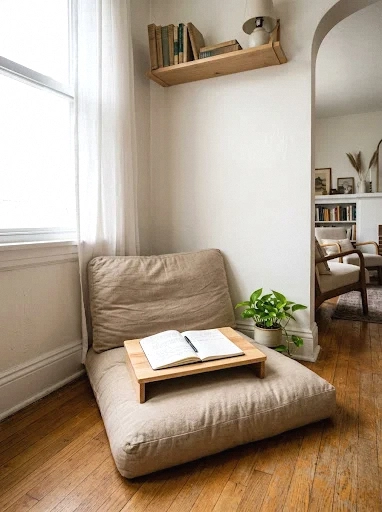
Bias lighting sits behind your monitor and casts a soft glow onto the wall behind the screen. It sounds subtle, but it does two real things for ADHD remote workers: it reduces eye strain from screen contrast, and it creates a visual frame around your monitor that draws your attention forward and keeps it there. It’s like putting a spotlight on the thing you’re supposed to be looking at.
LED bias lighting strips from Amazon run $15–$30. The Govee TV backlight strip is a popular option at around $20–$25 and includes a remote for color and brightness adjustments. Stick the strip to the back of your monitor and connect it to a USB port on the monitor itself. Set it to a warm amber or soft neutral white. Avoid changing the color constantly, which becomes its own novelty distraction. Pick one setting for work hours and leave it there.
Final Thoughts on Apartment Decor for Remote Workers With ADHD
You don’t need to do all 21 of these at once. The goal is to build a space that gives your ADHD brain fewer reasons to leave the task and more support for staying in it. A wall-facing desk, some closed storage, a visual timer, and a solid pair of noise-cancelling headphones gets you most of the way there for under $200. Everything else is a layer you can add when the budget and the need line up.
Start with whichever item on this list targets your biggest focus problem right now. If noise is destroying your mornings, grab the headphones first. If visual clutter is pulling your eyes away constantly, tackle the cable management and closed storage. One change this week, not all twenty-one.
Also, explore couples who both work from home.