

23 Kitchen Backsplash Tile Ideas That Actually Work on a Budget

Your kitchen backsplash is one of those things that looks fine until suddenly it really doesn’t. Maybe the grout’s gone grey, the tiles feel dated, or you just want the space to look like yours. It’s a small area but it carries a lot of weight.
This list of 23 backsplash tile ideas was built by digging through real homeowner forums, renovation threads, and actual project photos from people working with $100 to $300 budgets. Each idea was chosen because it works in a real kitchen, not a staged one. You’ll find options for renters, owners, first-timers, and people who’ve already ripped out one bad tile decision.
If you’re working with $100 to $300 and want something that looks genuinely good, you’re in the right place. This isn’t for people mid-renovation with a $3,000 budget. But you’ll be surprised what’s possible in this range.
By the end, you’ll know exactly which tile type fits your kitchen, what it’ll cost, and how to pull it off without regret.
If you’re also thinking beyond the backsplash, there are plenty of ways to refresh without major work that are worth a look before you commit to anything.
What to Know Before You Start Kitchen Backsplash Tile
- Most kitchens need 15 to 30 sq ft of tile behind the stove and counter area.
- Measure twice. Order 10% extra to cover cuts and breakage.
- Budget reality: basic ceramic tile runs $1 to $3 per sq ft. Glass starts at $5.
- Grout color changes everything. Dark grout on light tile reads completely differently than white grout.
- Skipping a primer coat on painted walls before tiling is the most common DIY mistake.
- Self-adhesive peel-and-stick tiles won’t hold above the stove. Heat makes them lift.
- Clean and degrease the wall fully before any tile goes up or it won’t bond properly.
- Sanded grout is for joints over 1/8 inch. Unsanded is for anything thinner.
1. Classic White Subway Tile

White subway tile has been around forever for a reason. It works in almost every kitchen style, from older homes to newer ones, and it doesn’t fight anything else in the room. The 3×6 inch format is the most popular, and you can find it at home improvement stores for as little as $1.50 per sq ft. That means a standard 20 sq ft backsplash can cost under $40 in tile alone.
The real decision is how you lay it. Straight horizontal stacking feels very traditional. But a vertical stack or a herringbone pattern changes the whole look without spending more money. Pair it with grey grout instead of white and the tile pops more than you’d expect. It’s one of those classic moves that still looks current in 2025.
It’s a good reminder that grout color changes the whole feel of a backsplash, and white tile is no exception.
2. Peel-and-Stick Marble Look Tile

You’re not fooling anyone up close, but from across the kitchen, peel-and-stick marble look tile genuinely looks nice. Brands like Smart Tiles and Art3d sell panels in the $30 to $60 range for enough to cover a typical backsplash. They go over existing tile or painted drywall without any thinset or grout.
The key is surface prep. The wall has to be clean, dry, and totally flat or the edges lift within a few months. Stay away from the area directly above your stove burners. The heat will cause them to peel. For renters, this is one of the few truly reversible backsplash options that actually looks finished when it’s up.
If you want to see more reversible options renters actually use, there’s a full breakdown worth reading before you buy anything sticky.
More Ideas:


3. Penny Round Mosaic Tile

Penny rounds are small circular tiles, usually about 1 inch in diameter, mounted on mesh sheets for easier installation. They’ve been trending in kitchens and bathrooms for a few years now and they still hold up. A white or cream penny round gives a retro diner feel that works really well in older homes or kitchens that lean into a vintage aesthetic.
I tried this in a small kitchen once and the install took a weekend but the result felt way more expensive than it was. Penny rounds usually run $4 to $8 per sq ft, so a 20 sq ft project lands around $80 to $160 in tile. The mesh backing makes them manageable for a first-time DIYer. Use unsanded grout since the joints are tiny.
4. Zellige-Style Handmade Look Tile

Zellige is a traditional Moroccan clay tile with an uneven, slightly glossy surface that catches light differently throughout the day. Real imported zellige is expensive, but American-made versions that replicate the look have come down a lot. You can find them for $5 to $9 per sq ft, which puts a 20 sq ft backsplash between $100 and $180 just in tile.
The texture variation is what makes it special. Each tile sits slightly differently, so there’s a handcrafted quality that flat ceramic just doesn’t have. It works well in kitchens that lean warm or earthy, especially with wood cabinets or open shelving. White and off-white are the most versatile colors but terracotta and sage are both having a real moment right now.
5. Subway Tile in a Herringbone Pattern
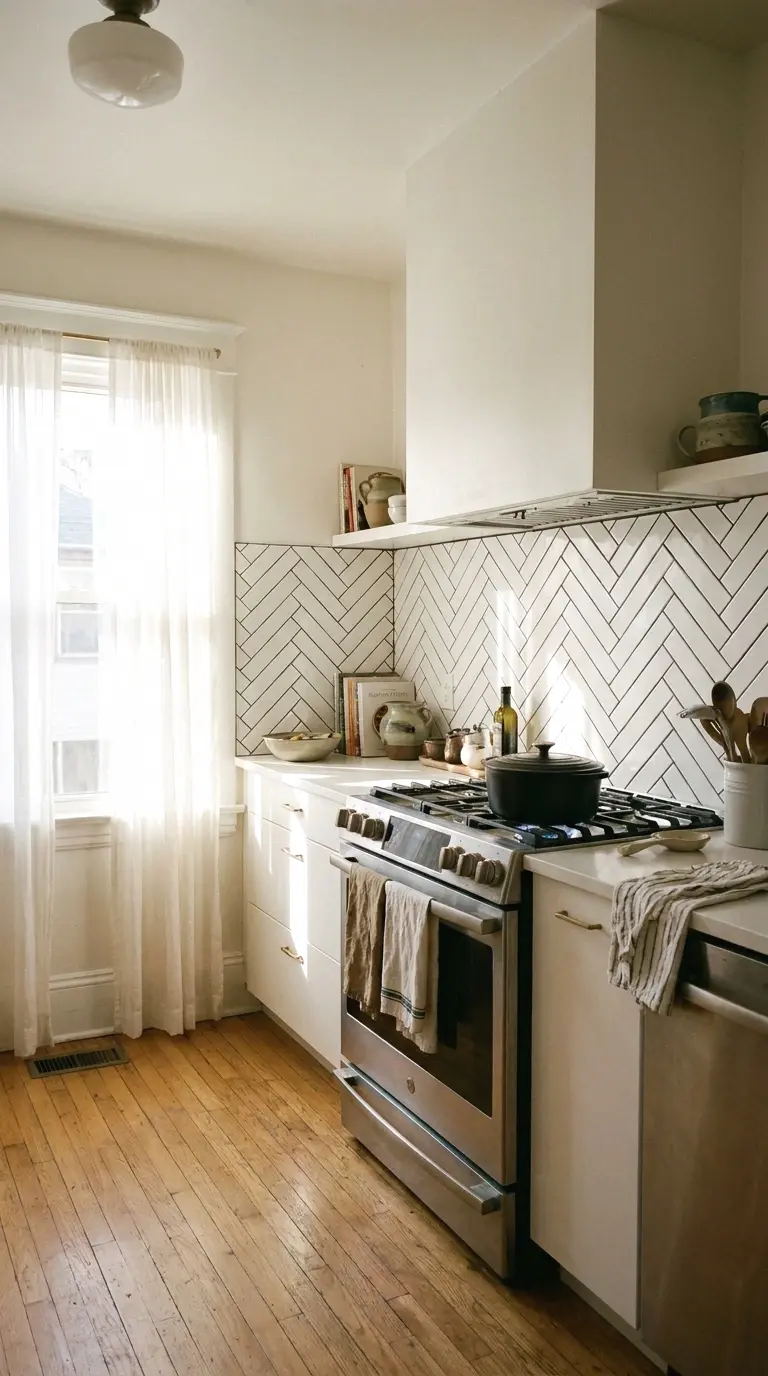
Here’s the thing about herringbone. It’s the same tile, same price, but the pattern does so much more work on the wall. A basic white or grey subway tile laid at 45-degree angles creates a visual texture that reads as a design choice, not just a backsplash. Most people see it and assume you spent more than you did.
The cut waste is higher than straight stack layouts, so order 15% extra instead of 10%. A tile saw or a tile cutter rental from the hardware store is worth it for clean diagonal cuts. If you’re tiling behind a stove or range hood, herringbone draws the eye upward in a way that makes the kitchen feel taller. I’ve seen this pull together a rental kitchen that had basically nothing else going for it.
6. Stacked Stone Ledger Panel

Ledger panels are flat pieces of real or faux stone stacked in a pattern that looks like a stone wall. They come in 6×24 inch strips and interlock along the edges. Real stone ledger panels start around $8 per sq ft but there are faux options that look very similar for $4 to $6. For an accent section behind the stove, a small run might cost $60 to $100 total.
This works best as a feature moment rather than a full backsplash. A single wall behind the range with ledger stone against flat painted tile on the rest of the wall creates a focal point without covering everything in the busier texture. Slate and quartzite tones in charcoal, tan, and rust all work well in this context.
More Ideas:
7. Arabesque Tile
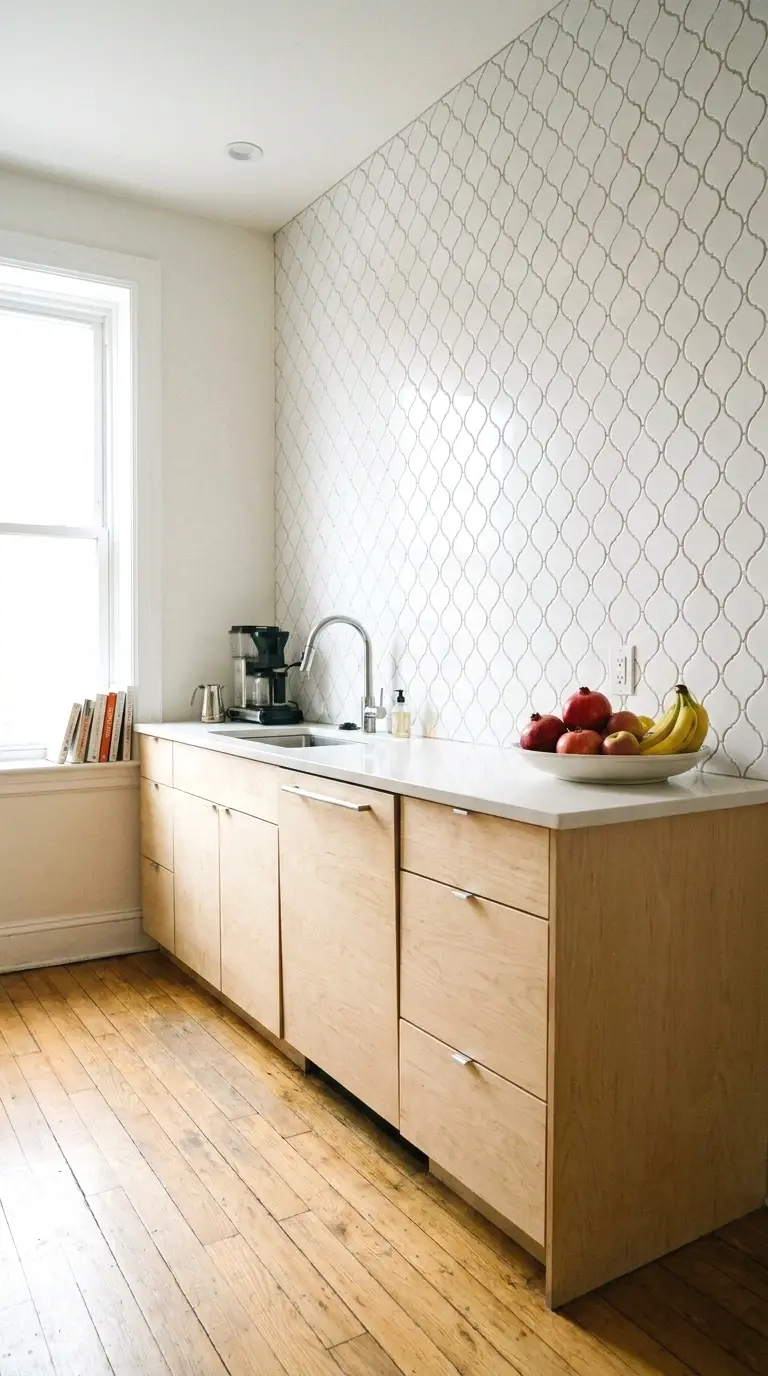
Arabesque tiles have a pointed oval shape, like a stretched Moroccan arch, and they interlock into a pattern that looks far more complicated than it is to install. The shape is the decoration so you don’t need to do anything special with the layout. Just mount them as directed and the pattern forms itself.
These usually run $3 to $7 per sq ft depending on the material. White is the most common color but they also come in soft blues and greens that look great in kitchens with light wood or white cabinets. The grout joint width matters here. Thin joints in the same color as the tile give a more modern look. Wider contrasting grout makes the shape of each tile stand out more.
8. Cement Look Porcelain Tile

Porcelain that mimics the look of cement tile has gotten really good. The surface has a flat, matte finish with subtle texture variation that looks like the real thing without the sealing and maintenance that actual cement tile needs. It’s also more durable for kitchen use since it doesn’t absorb grease or water the way cement does.
You can find cement look porcelain for $2 to $5 per sq ft at most tile or flooring stores. The most popular format is 4×4 or 6×6 inches. It suits kitchens going for an industrial or modern look, especially with black or matte hardware and open shelving. The muted grey and warm greige tones are the most popular in 2025 for this style.
If you’re drawn to tile that suits an industrial space, the rustic end of the spectrum has some strong options that pair well with this finish.
9. Thin Brick Tile
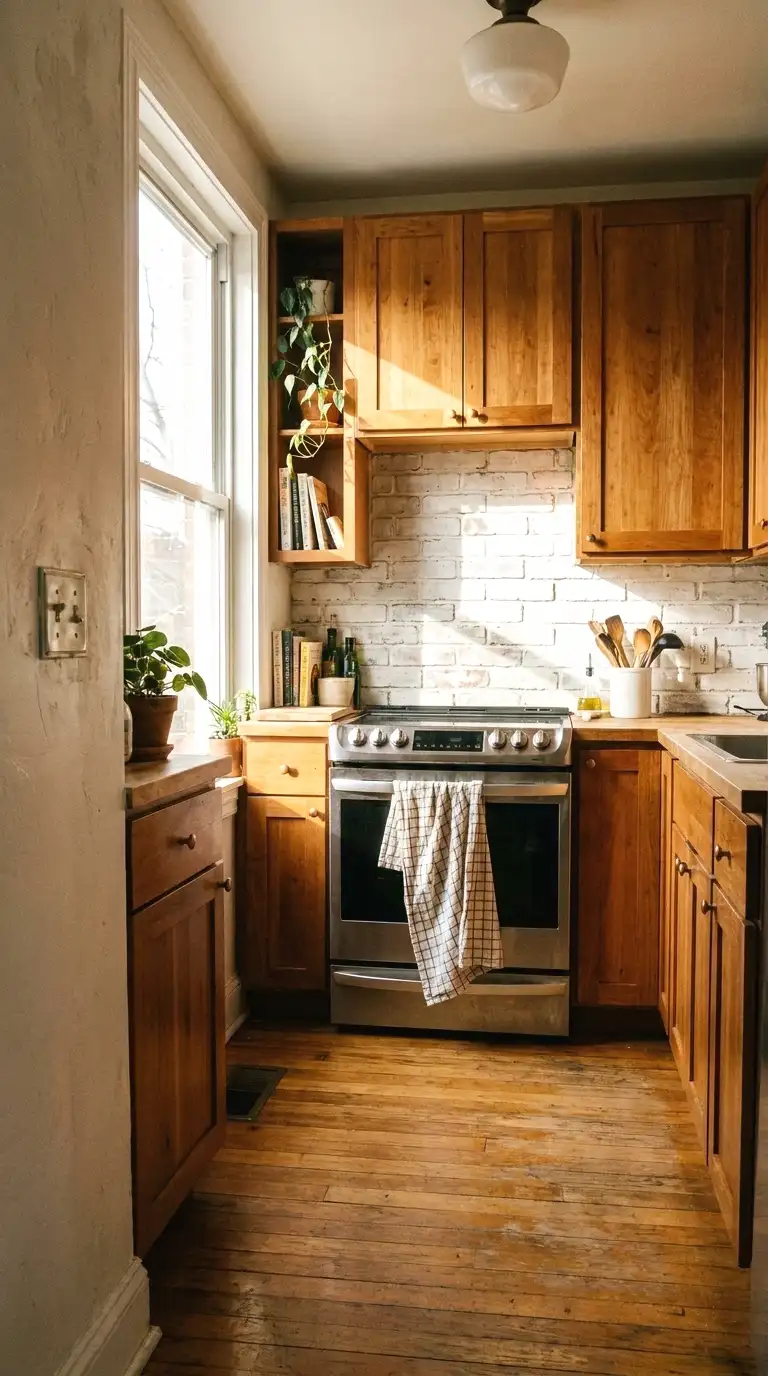
Thin brick tile is real kiln-fired clay brick that’s been sliced down to about half an inch thick. It installs like regular tile and gives you an actual exposed brick look on the wall without tearing anything out. This is one of my favorite options for older homes or kitchens that have character already and just need the backsplash to match.
Prices usually sit around $4 to $7 per sq ft. The most popular colors are red, rustic brown, and whitewashed. Whitewashed thin brick in particular is having a moment in 2025, especially in kitchens with earthy or farmhouse leanings. The mortar joint look is already built into the format so there’s not much finishing work needed after the tile goes up.
For more farmhouse kitchen details worth stealing, there’s a dedicated round-up that covers this style in much more depth.
10. Glass Subway Tile

Glass subway tile is the same format as ceramic subway tile but with a depth and reflectivity that ceramic doesn’t have. It bounces light around the kitchen and makes the space feel a bit larger and brighter. That’s especially useful in kitchens that don’t get great natural light.
It costs more than ceramic, usually $5 to $10 per sq ft, but for a 20 sq ft backsplash the total tile cost is still often under $200. Installation is similar to regular tile but requires white thinset instead of grey so the color shows through cleanly. Soft blues, seafoam, and warm whites are the most popular colors for glass subway tile and all of them look good with brushed nickel or chrome fixtures.
If you like the idea of light bouncing off coastal tile, there’s a whole collection of seaside-inspired backsplash ideas that go deeper on this color palette.
More Ideas:
11. Chevron Pattern Tile

Chevron is the V-shaped zigzag pattern that often gets confused with herringbone. The difference is that chevron tiles are actually cut at an angle on each end so the points meet perfectly. It creates a sharper, more graphic look than herringbone, which has small offset gaps at the peaks.
Chevron tile sheets in white or light grey run about $3 to $6 per sq ft. They come on mesh backing so the install isn’t as complicated as the pattern suggests. I was skeptical about this one because it looked busy in photos, but in a real kitchen with simple white cabinets it settles into the wall nicely. It gives the backsplash a modern geometry without overwhelming everything else.
12. Vertical Stacked Subway Tile

Take a basic subway tile and turn it vertical. Stack it straight up in a column pattern instead of horizontal bricks and you get a completely different look. Vertical stacking makes ceilings feel higher, which is especially useful in kitchens with standard 8-foot ceilings that can feel a bit closed in.
This works best in longer stretches like behind the range or across the full counter run. The tile cost is the same as any other subway installation, $1.50 to $3 per sq ft for ceramic. But the visual result reads as a deliberate design choice rather than default tile placement. Pair it with a slightly contrasting grout color to make the lines visible without going too bold.
13. Terrazzo Look Tile

Terrazzo is that speckled composite material you see in old buildings and modern cafes with multicolored chips embedded in a light base. The real version is poured in place and expensive. The tile version captures the look without the complexity or cost.
Terrazzo look porcelain tiles run $3 to $6 per sq ft and come in several colorways. The most popular for kitchens are white or light grey bases with small flecks of black, warm taupe, or blush pink. It’s a busy pattern that works best when everything else in the kitchen is simple. White or natural wood cabinets with clean hardware let the terrazzo tile do its thing without competing with anything.
Thinking about the cabinets and counters that anchor the room is just as important as the tile, especially when the backsplash pattern is doing a lot of visual work.
14. Picket Tile

Picket tiles are elongated hexagon shapes, wider in the middle and pointed at both ends, like the slat of a fence. They’re related to the subway tile family but the shape adds a directional flow that flat rectangular tiles don’t have. Pointed up, they give a subtle art deco feel. Pointed sideways in a horizontal run, they look more modern.
White picket tile usually runs $2 to $5 per sq ft. The pointed ends mean a bit more cutting at edges and outlets, so order closer to 15% extra. This is one of those tile shapes that’s been around for decades but never really goes out of style. It’s popular in 2025 especially in kitchens going for a clean, polished look without anything too trendy.
More Ideas:
15. Bold Patterned Encaustic Style Tile

Encaustic tile is the old-fashioned kind with geometric or floral patterns pressed into colored cement. The traditional version is expensive and high maintenance. But porcelain versions that print the same patterns onto a durable base have become widely available for $4 to $8 per sq ft.
The key with patterned tile is using it as a true accent. One or two rows along the counter edge or a full panel behind the stove only, with plain tile elsewhere, keeps the pattern from reading as too much. Navy and white, terracotta and cream, and black and white geometric patterns are all strong choices in 2025. (This one is so underrated.) A small amount goes a long way and the impact is real.
For more inspiration on patterned tile used as a focal point, there’s a broader backsplash gallery with a lot of real-kitchen examples.
16. Hexagon Tile

Hexagon tiles have been popular for a while now and they’re still a strong choice, especially in kitchens trying to move away from the straight-line subway look. Small hexagons, the 1 or 2 inch size, come on mesh backing and install as sheets. Larger hexagons, 4 to 6 inches, install individually and have a bolder look.
Small white hex tile with grey grout is the most classic version and it runs about $3 to $5 per sq ft. But black hex tile with white grout has a stronger, more graphic quality that reads really well in modern or industrial kitchens. Both work. The size you choose depends on how much pattern you want. Smaller tiles create more visual texture. Larger ones feel cleaner and simpler.
17. Crackle Glaze Ceramic Tile

Crackle glaze is a surface treatment on ceramic tile where the glaze is intentionally cracked during firing, creating a web of fine lines across the surface. It’s subtle up close and gives the tile an aged, handmade feel that fits really well in traditional, farmhouse, or Mediterranean-style kitchens.
You can find crackle glaze tile for $2 to $5 per sq ft. It’s usually white or off-white but also comes in dusty blues and greens. The crackle pattern doesn’t compromise the tile’s function. It still cleans easily and holds up the same as plain ceramic. This is one of those details that most people don’t notice right away but when they do, it reads as a thoughtful choice rather than a standard tile decision.
18. Subway Tile in Dark Colors

White subway tile is everywhere. Black, charcoal, forest green, and navy subway tile are less common but just as easy to install and the result is a completely different kitchen. Dark backsplash tile behind a light or white counter creates contrast that makes both elements stand out more clearly.
Dark ceramic subway tile costs about the same as white, $1.50 to $3 per sq ft. Sage green and deep teal have been popular since 2023 and are still strong in 2025 especially in kitchens with brass or warm gold hardware. Black tile with black grout creates a tone-on-tone look that feels very current. (Took me ages to figure this out but matching grout to tile almost always looks more intentional than contrasting it.)
More Ideas:
19. Scallop or Fish Scale Tile

Scallop tiles are fan-shaped, like the overlapping scales of a fish. They stack in offset rows and the curved edges create a wave-like pattern across the wall. It’s a distinctive shape that reads differently depending on the color. White is soft and retro. Dusty blue or pale green reads more organic and modern.
These tiles usually run $4 to $8 per sq ft and come in both ceramic and glass versions. The glass version is more expensive but catches light really nicely in kitchens with under-cabinet lighting. The ceramic version is the more affordable entry point and works just as well for the pattern. Use a matching grout color to keep the look soft, or go slightly contrasting if you want the scale shapes to stand out more.
20. Elongated Hexagon Tile

Regular hexagons are equal on all sides. Elongated hexagons are stretched vertically, which gives them a more directional quality. The shape has a slightly more modern, less retro feel than the classic hex format. It’s a small design detail but the visual effect is noticeably different.
Elongated hex tiles usually run $3 to $6 per sq ft in ceramic. White with a thin grey grout joint is the most popular combination. But off-white or warm cream with a tinted grout can give the same shape a much softer quality that works better in kitchens leaning toward organic or natural aesthetics. These tiles look especially good behind open shelving where the full field of the pattern is visible without cabinets interrupting it.
21. Rectangular Tile in a Stacked Bond Pattern

Stacked bond means all the tiles line up perfectly both horizontally and vertically, with no offset. It’s the most minimal layout option and it creates a very clean, grid-like wall. This is the layout that reads most modern in 2025, especially in kitchens with flat-front cabinets and simple hardware.
The same ceramic tile that would look fairly standard in a brick offset layout looks noticeably more intentional in a stacked bond. You can use standard subway tile or a slightly taller rectangle like 3×8 or 4×12 for a stronger vertical grid. Cost is the same as any other ceramic tile project, under $3 per sq ft for the tile itself. The precision of the layout requires careful spacing and level lines but no special tools.
22. Two-Tone Tile Design

Two-tone means using two different tiles in one backsplash, usually divided horizontally. A common version is a row or two of a patterned or textured tile at the counter level, then plain tile above. Another version uses the same tile in two different colors, split by a thin accent strip in the middle.
When I tried this in my own space, I used white subway tile above the counter and a single row of deep blue pencil tile as a border strip. The total cost was under $80 for the tile and it made the whole wall feel more considered than a single tile would have. The key is keeping the two tiles closely related in finish and scale so the combination feels deliberate rather than accidental.
More Ideas:
23. Solid Color Matte Porcelain Slab Look

Large format matte porcelain tile cut to fit the backsplash area gives a seamless, almost no-grout-line look that’s become very popular in modern and minimalist kitchens. The tile size, usually 12×24 or larger, means fewer grout lines across the whole wall. With a matching grout color, the wall reads almost like a single surface.
Matte porcelain in this format runs $3 to $7 per sq ft. Warm whites, soft sage, dusty terracotta, and charcoal are the most popular colors right now. This is one of the cleaner, quieter options on this list but the result in the right kitchen is really impressive. It works best when the rest of the kitchen has some visual detail to anchor it, since the backsplash itself is intentionally minimal.
Final Thoughts on Kitchen Backsplash Tile
You’ve now got 23 real options across basically every style and budget in the $100 to $300 range. Some go bold with pattern and shape. Others keep it quiet and let the finish do the work. The common thread is that none of them require a contractor or a big renovation budget to pull off.
Start with the area that bothers you most. If it’s behind the stove, pick one of the accent options. If it’s the full wall, measure it first and figure out your sq ft number before choosing a tile price point. One solid weekend and a clear plan is enough to get most of these done.
And don’t overlook the wall color behind the whole setup — even a small exposed section above the tile can shift how the entire backsplash reads.
If you want more ideas like these, homelypop.com has a lot more where this came from. Real budgets, real rooms, real results.


