
22 Bedroom Color Schemes to Transform Your Sleep Space Into a Beautiful Retreat

You’ve repainted your bedroom twice and it still feels off. The colors looked great on the swatch but weird on the wall. Or maybe everything blends into one big beige blur and you can’t figure out why it feels so flat and forgettable. You know the room has potential. You just can’t pin down what’s missing.
These 22 bedroom color schemes were picked from real homes, real budgets, and real mistakes people made before landing on something that actually worked. Each idea was chosen because it solved a specific problem, whether that’s a room that gets no natural light, a rental with ugly fixtures you can’t change, or a space that needs a full personality without a full renovation. Most fall in the $100–$300 range.
This list is for people who want results they can see without hiring anyone or gutting the room. It’s not for people looking for full custom paint jobs or professional design consultations. You can do every idea here yourself, even if you’ve never done it before.
By the end, you’ll know exactly which color direction fits your room, your light, and your budget.
If you want a broader starting point before diving in, there are plenty of ideas from real homes styled on a budget worth browsing first.
What to Know Before You Start Choosing Bedroom Colors
- Paint undertones matter more than the color name. A “gray” can read purple, green, or blue depending on your lighting.
- Test paint samples on a 12×12 inch section of your actual wall, not on white paper.
- Flat finish hides wall flaws. Eggshell is easier to clean. Satin works best near windows.
- A single accent wall costs roughly $30–$60 in paint versus $120–$200 for a full room repaint.
- Most people overlook the ceiling. Painting it one shade darker than the walls adds depth without extra furniture.
- Warm whites (like SW Alabaster) work in south-facing rooms. Cool whites (like BM Chantilly Lace) work in north-facing rooms.
- Don’t match your wall color to your bedding exactly. A slight contrast makes both look more intentional.
- Repaint baseboards white when switching to darker walls. It takes one hour and makes a big difference.
1. Warm White With Wood Accents

Warm white is one of those colors that sounds boring until you actually see it done right. It’s not the sharp, cold white you find in offices. It’s the kind of white that looks like morning light hit a linen sheet. Sherwin-Williams Alabaster and Benjamin Moore White Dove are the two I hear about most from people who finally got their bedroom to feel settled and calm. Pair it with natural wood nightstands or a headboard in a medium walnut or honey oak tone and the whole room breathes.
The budget here is really approachable. A gallon of quality paint runs about $40–$55, and if you already have wood furniture you like, this scheme costs almost nothing to pull off. When I tried this in my own space, I was shocked how much warmer and more finished the room felt. It’s one of the most underrated combinations out there.
2. Deep Navy With Brass Details

Navy blue walls make a bedroom feel like it has actual weight to it. There’s something about a deep blue that makes a room feel contained and restful instead of just empty. It works especially well in rooms with low natural light because the depth of the color takes away that “basement” feeling that pale walls sometimes make worse. Go with something like Hale Navy by Benjamin Moore or Naval by Sherwin-Williams. Both read as true navy without going too purple.
The brass part doesn’t have to be expensive. A $15 outlet cover, a $25 lamp, or a $40 curtain rod in brushed brass ties everything together. Full room paint cost is around $80–$120. This is a look you’ll see all over design boards right now, and it holds up long term because navy is a classic direction. It doesn’t feel like a trend you’ll regret in two years.
If deep moody walls done right appeal to you, there’s a whole range of directions beyond navy worth considering.
3. Sage Green With Cream Linen

Sage green has been all over homes for the past few years and there’s a good reason for it. It reads as natural without being loud. It’s the color of dried herbs and old gardens. Paint your walls in something like Behr Sage Advice or Farrow and Ball Mizzle and pair it with cream linen bedding and light curtains. The result is a room that feels grounded without feeling dark. It works in small bedrooms especially well because it doesn’t compete for attention.
Linen bedding sets in cream or oat run $60–$120 for a good quality queen set. The paint is about $40 a gallon. So the whole scheme, including new bedding and a fresh coat, stays easily under $200. This combination photographs well too, which sounds like a weird thing to mention but it’s the kind of room you actually want to spend time in. That matters.
Earthy green tones for small rooms show up especially well when layered with natural textures and warm bedding.
4. Dusty Rose With Warm Gray

This one surprises people. Dusty rose sounds like a grandma’s bedroom from the 1980s but the updated version is softer and more muted, closer to a terracotta pink or a faded blush. Try Benjamin Moore Pale Blush or Behr Victorian Garden. Pair it with a warm medium gray on one accent wall or through your bedding and throw pillows. The gray keeps the pink from going too sweet and the pink keeps the gray from feeling cold.
You can do this one without touching the walls at all if you rent. Dusty rose bedding plus gray curtains and one or two gray throw pillows does most of the work. A good bedding set in this color palette runs around $50–$90. If you do paint, one accent wall in dusty rose costs about $30–$40 in paint and an afternoon of your time.
5. Charcoal With Soft Gold

Charcoal is a dark neutral that does what black wants to do but more gently. It doesn’t make a room feel like a cave. It makes it feel intentional. Use it on just one wall behind the bed or go full room if you have decent light. Soft gold accents, not shiny metallic gold but matte or antique gold, bring warmth into the space so it doesn’t turn cold and heavy. Think gold frames, a warm bulb pendant light, or textured gold throw pillows.
The trick with charcoal is to keep your bedding light. White or ivory against a charcoal wall is one of the cleanest looking combinations in a bedroom. Full room paint in a charcoal costs around $80–$110. Accent pieces in soft gold can come from thrift stores or discount home shops for under $50 total. This is a scheme that feels higher-end than it actually costs.
6. All-White With Texture Layers

An all-white bedroom sounds like it could go very clinical very fast. And it does, if you do it wrong. The key is texture. White woven throw, white linen duvet with some visible weight to it, a cream knit blanket folded at the foot of the bed, white curtains with a subtle pattern. When all the whites are slightly different, the room reads as layered and intentional instead of flat and boring. It’s also the easiest to adapt over time without repainting.
Building a layered neutral bedroom without repainting is a skill worth learning if you rent or plan to move.
This is one of the most budget-friendly starting points because white paint is often cheaper and you can add texture gradually. A solid white wall paint like Chantilly Lace by Benjamin Moore costs about the same as any other color. Textured bedding and throws can be added $20 to $30 at a time. (This one is so underrated, especially for renters who don’t want to commit to a bold wall color.)
7. Terracotta With Natural White
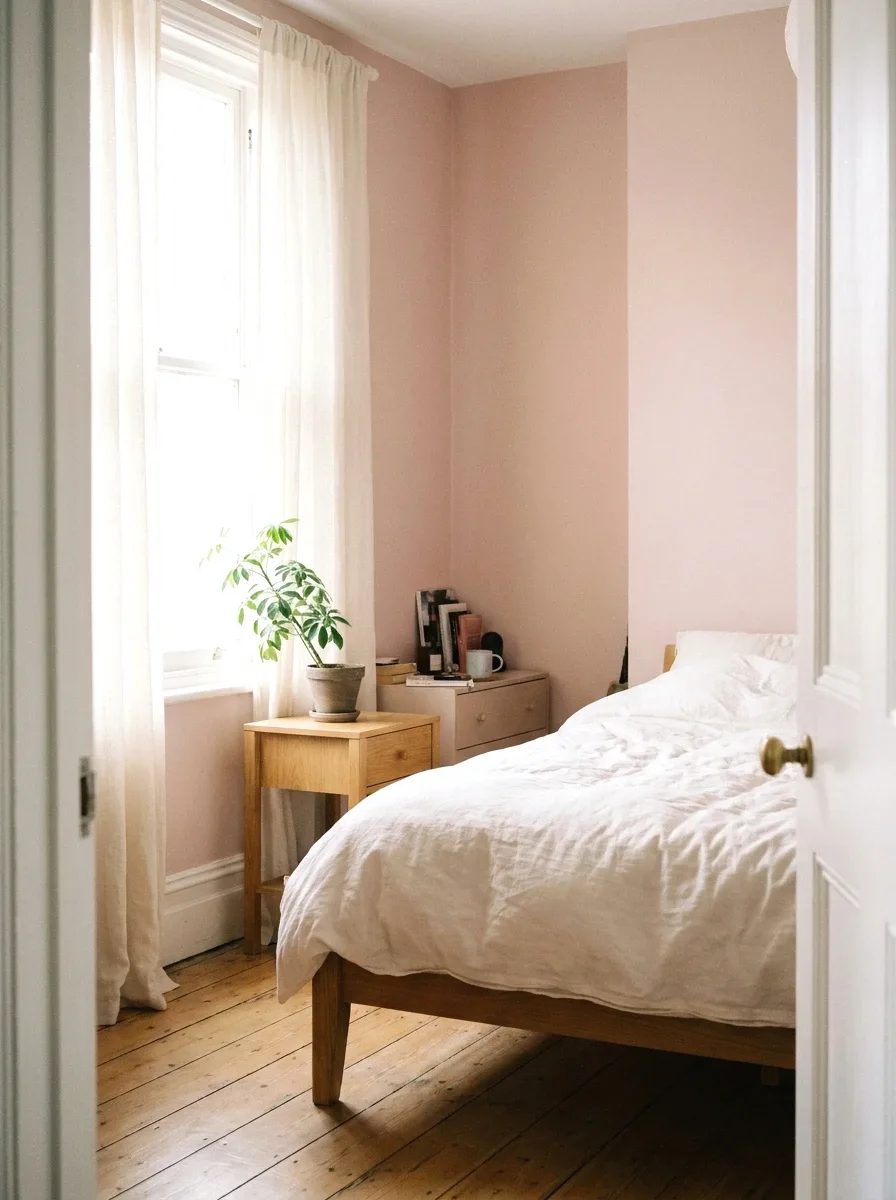
Terracotta is earthy, warm, and really good in bedrooms that get afternoon light. It’s in the orange-red-brown family but muted enough that it doesn’t feel aggressive. Behr Fired Earth and Sherwin-Williams Cavern Clay are two colors people come back to again and again. Pair it with natural white, not a bright cool white, on trim, bedding, or even a second wall. The contrast stops terracotta from going too heavy.
You don’t need to paint all four walls. One accent wall in terracotta behind the headboard with white everywhere else is enough to feel the impact. That’s one gallon of paint at $40–$50. Add a white linen duvet and some natural woven baskets and you have a scheme that looks put together without being expensive. I was skeptical about this one but it’s one of the warmest, most livable bedroom colors I’ve seen done well in real homes.
8. Moody Forest Green
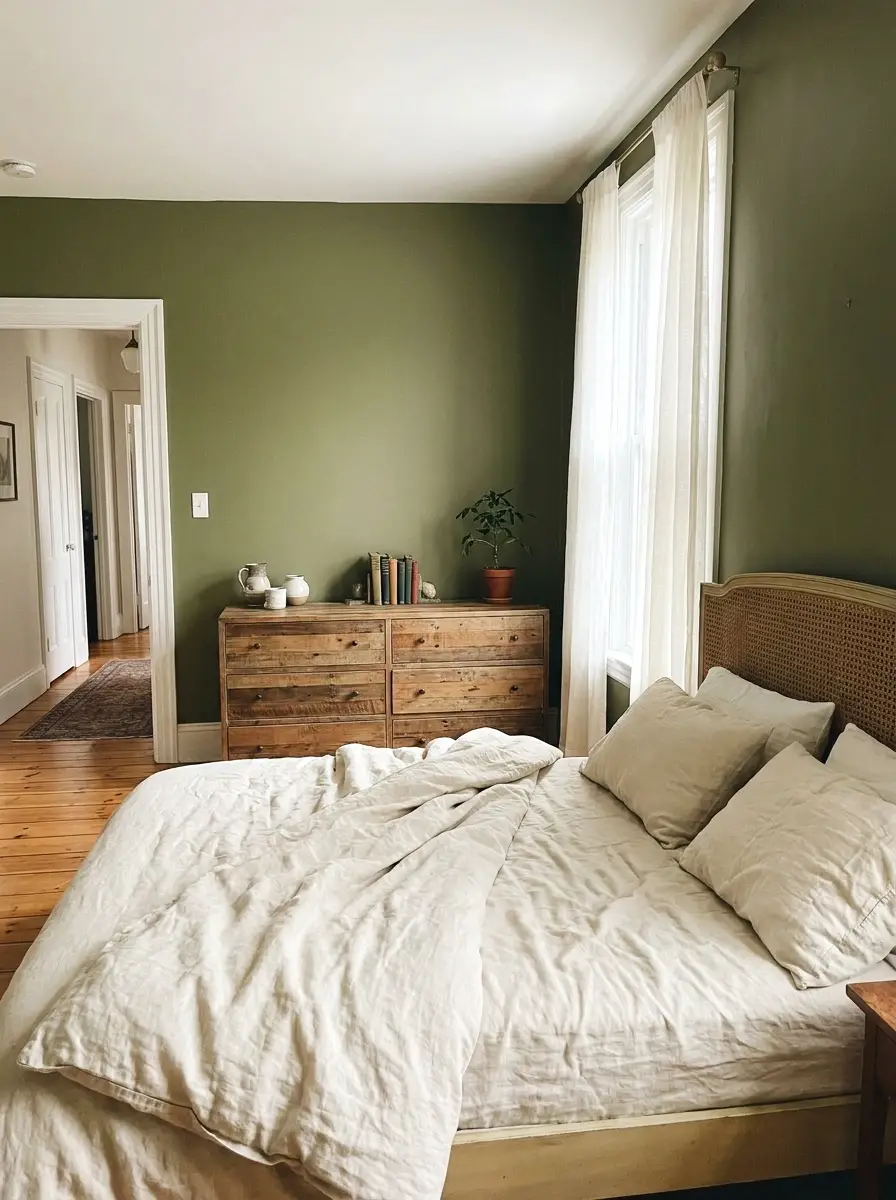
Forest green in a bedroom sounds scary to a lot of people. It’s dark, rich, and it takes commitment. But done right, it creates one of the most restful rooms you’ll find. Think Hunt Club Green by Benjamin Moore or Hedge Green by Sherwin-Williams. The color wraps the room in a way that makes it feel like its own separate world from the rest of your house. Use it with warm white bedding, natural wood floors or a jute rug, and warm-toned lighting.
Keep ceiling the white and keep the window trim bright. This stops the room from feeling like a closet. The paint cost for a full room is around $80–$150 depending on room size. It’s a bigger commitment than an accent wall but the payoff is a room that doesn’t look like every other bedroom on every other home tour. It’s distinctive. And it works.
Forest green as a full room color pairs especially well with the kind of raw, natural styling covered in wabi-sabi-inspired approaches.
9. Lavender With Warm Walnut

Lavender is having a moment right now and for good reason. The newer versions are more muted and smoky than the bright purple most people grew up with. Try Behr Mountain Haze or Benjamin Moore Pale Iris. Both sit right in that gray-lavender zone that feels soft without being childlike. Pair with warm walnut furniture, a wood nightstand, a walnut headboard, and the warmth of the wood pulls the lavender away from feeling cold.
This is a great scheme for north-facing rooms because the warmth in the wood furniture counters the cool undertone of the lavender. Total paint cost sits around $40–$60 for an accent wall. If you add a walnut-look nightstand from a furniture discount store, you’re looking at $60–$120 extra. Under $200 total for a really finished result.
10. Blue-Gray With White Trim

Blue-gray is one of those colors that sells houses. There’s a reason it shows up in nearly every professionally staged bedroom. It reads as calm, polished, and neutral without being as flat as plain gray. Passive by Sherwin-Williams is the fan favorite. Benjamin Moore Gray Owl is another. The key is keeping your trim, doors, and ceiling bright white. That contrast makes the wall color look purposeful and the trim look sharp.
Budget-wise this is one of the easiest schemes to pull off. The color is available in every price range of paint. Gallon runs $35–$55 depending on brand. White trim paint is cheap and widely available. If your trim is already white, this is a one-paint project. Total cost under $100 for most average-sized bedrooms. Clean result, takes a weekend, and photographs beautifully if you ever list the home.
11. Warm Beige With Rust Accents

Beige has a bad reputation because people confuse it with boring. But warm beige with a red-orange rust accent is a combination that’s rich and grounded in a way a lot of bright color palettes aren’t. Use Accessible Beige or Balanced Beige by Sherwin-Williams as your wall color. Then bring in rust through pillows, a throw blanket, or even a rust-colored rug.
The rug is the most impactful piece here. A rust-toned area rug under the bed, even a 5×8 foot size, anchors the whole room and makes the beige walls look like a deliberate backdrop. A decent 5×8 rug in rust tones runs $80–$180. Paint for the full room is around $60–$90. You can also find rust-colored throw pillows for $15–$25 each at most home stores. Total scheme under $300 if you shop it sensibly.
12. Soft Black With Natural Linen

Soft black, sometimes called off-black or deep charcoal-black, is different from a pure flat black. Colors like Tricorn Black by Sherwin-Williams or Off-Black by Farrow and Ball have a warmth to them that makes them livable in a bedroom. The key is pairing with very natural, raw-feeling textiles. Undyed linen, unbleached cotton, raw canvas curtains. The contrast between the dark wall and the raw natural fabrics makes the room feel collected and layered.
This works especially well in small bedrooms because it stops the eye from focusing on the size of the room. It focuses on the feel instead. (Took me ages to figure this out.) Accent wall cost is around $40–$55. Natural linen duvet covers run $60–$100. The total investment for a really striking scheme stays under $200 if you do just one wall in the dark color.
13. Ice Blue With Silver Gray

Ice blue and silver gray together create a bedroom that feels genuinely restful. It’s cool, quiet, and uncluttered. Ice blue reads as almost white in low light but comes alive during the day. Benjamin Moore Breath of Fresh Air or Sherwin-Williams Aloof Gray are good options that hit this range. Pair with silver gray accents through frames, light fixtures, or bedding in a cool gray tone.
This scheme is especially good if you run warm when you sleep or if your room gets hot afternoon sun. The cool palette makes the room feel a few degrees lighter. Paint cost is in the standard $40–$55 range. Silver-toned frames can be found at thrift stores for almost nothing, and gray bedding is widely available from $50 up. It’s a calm, quiet direction that doesn’t shout for attention.
Soft muted palettes for restful spaces are a core part of design approaches that prioritize calm over decoration.
14. Warm Taupe With Caramel

Taupe and caramel is one of the warmest, most welcoming combinations you can put in a bedroom. Taupe reads as a warm brown-gray that feels very natural and settled. Caramel accents, through a throw, a wooden lamp base, or leather nightstand accessories, add a richness that keeps the taupe from going flat. Try Accessible Beige or Alpaca by Sherwin-Williams for the wall and layer in caramel tones through accessories.
The whole scheme works with furniture you probably already have. If you have natural wood or medium brown furniture, this palette works with it instead of against it. You might only need new bedding and a couple of throw pillows in caramel tones to make it click. That’s $50–$100 if you shop the sales. Paint on top of that is another $40–$60. Well under $200 for a really put-together result.
15. Olive Green With Cream

Olive is darker and earthier than sage but lighter than forest green. It sits in a really useful middle ground that works with a huge range of furniture and flooring. Sundried by Behr and Dried Thyme by Sherwin-Williams are two versions that work in real homes without feeling too intense. Pair with cream, not white, bedding and curtains. Cream softens the olive and keeps the room from going too heavy.
This combination works well with vintage or second-hand furniture because olive green has a slightly aged, natural quality that pairs with character pieces. A found wooden dresser, an old cane headboard, an inherited lamp all look more intentional against an olive wall. Paint cost around $40–$55. New cream bedding runs $50–$100. If you’re starting from scratch, the scheme fully built out stays under $200.
Vintage furniture paired with earthy walls is a combination that cottage-style bedrooms have been doing well for a long time.
16. Blush Pink With Warm White

Blush pink is softer and more grown-up than most people expect. The right version is barely there, more of a pinkish off-white than an obvious pink. Try First Light by Benjamin Moore or Pale Dogwood by Sherwin-Williams. Pair with warm white bedding and curtains, not a stark cold white. The two whites sit together comfortably and the blush wall adds just enough color to keep the room from feeling empty.
This is a great scheme for people who want color but are afraid of commitment. Blush is close enough to white that if you ever want to repaint, one coat of white covers it without needing primer. Paint cost is the same as any other color, $40–$55. The result is soft, light-filled, and much easier to live with long-term than people expect when they first try it.
17. Midnight Blue Ceiling

Here’s one people don’t think about: paint just the ceiling instead of the walls. A midnight blue ceiling in a bedroom with white or pale walls creates a canopy effect that makes the room feel enclosed in a good way, like sleeping under a sky. Use a deep saturated blue on the ceiling, something like Gentleman’s Gray by Benjamin Moore, and leave all four walls completely white.
The cost of painting just a ceiling is usually one gallon at most, around $40–$55. It takes two to three hours including prep. The result is dramatic enough that you don’t need to touch anything else. This works especially well in rooms where the ceiling is on the lower side because the dark color makes the ceiling feel intentional rather than just close. It’s one of the more unexpected ideas on this list but it consistently looks really good.
18. Warm Mustard With Deep Brown

Mustard yellow in a bedroom sounds risky. And it is if you go too bright or too much of it. The version that works is a muted, earthy mustard, like Tricycle by Benjamin Moore or Vintage Gold by Behr. Use it on one accent wall behind the bed only. Pair with deep brown furniture or bedding. The combination reads as rich and collected, very much like an autumn afternoon in a good way.
The accent wall approach here keeps the budget low and the risk manageable. One gallon of paint, one weekend afternoon. If the color doesn’t work the way you hoped, you repaint it. But in the right room with the right light, this combination looks really good. Deep brown bedding sets run $60–$100 and warm the whole scheme up. Total under $160 for a really distinctive look.
19. Two-Tone Walls: Lower Third in a Darker Shade

Two-tone walls use a chair rail or just a painted line at about 36 inches to divide the wall into two sections. The bottom third or half goes darker, the top half stays lighter. It’s a classic technique that looks expensive and takes only an afternoon plus about $60–$80 in paint for both colors. Use the same hue in two shades, a deep sage on the bottom and a pale sage on top, for a pulled-together result.
So here’s the thing about two-tone walls: they add visual weight to the lower portion of the room, which makes ceilings feel taller. That’s the whole reason it’s been used in traditional homes for decades. You can do a rough line at 36 inches or buy a chair rail molding for $10–$20 at the hardware store and attach it for a more finished look. Really good value for the visual payoff.
20. Earthy Brown With Warm Cream

Full brown walls might be the most underestimated bedroom direction in the past ten years. Rich earthy browns like Chocolat by Benjamin Moore or Brown Sugar by Sherwin-Williams create rooms that feel genuinely warm and settled in a way that lighter neutrals can’t touch. Pair with warm cream bedding and light natural textures: rattan, cotton, undyed linen.
The key is getting the right brown, one that leans warm and red-orange rather than cold and muddy. Cool browns can feel gray and lifeless. Warm browns feel grounded and rich. Paint cost for a full room is $80–$120. If you add cream linen bedding at $60–$100, you’re still comfortably under $250. And this is a scheme that looks genuinely considered, not like a default choice.
21. Pale Yellow With White

Pale yellow is different from bright yellow the same way blush is different from hot pink. Benjamin Moore Pale Moon or Sherwin-Williams Cream are soft, almost neutral versions that add warmth to a room without making it feel like a nursery. In a north-facing room, pale yellow can fake the effect of sunlight even on a gray day. That’s not nothing when you’re waking up in winter.
Warm bedroom colors for north-facing rooms are worth exploring further if your space struggles with natural light in colder months.
Pair with clean white trim, white bedding, and natural wood accents. The wood stops the pale yellow from feeling too sugary. Paint is the same cost as any other color at $40–$55. This is a great scheme for people who have tried and failed with cool neutrals in a room that just never feels warm enough. It solves that problem quietly without being loud about it.
22. Greige With Warm Metals

Greige is the word for colors that sit right on the line between gray and beige. Agreeable Gray by Sherwin-Williams is the most famous one. It works because it pairs with almost any furniture color you already have and reads as neither too cool nor too warm depending on the lighting. Pair it with warm metals through your light fixtures, mirror frame, and hardware to give the neutral scheme some personality.
Brushed brass or oil-rubbed bronze hardware can swap out on existing light fixtures for $20–$40 per piece. A brass mirror runs $40–$80. The paint itself is one of the most reliably good neutrals you can buy for $40–$55 a gallon. This is the scheme you choose when you want the room to feel polished and settled without drawing attention to any one element. Calm but considered.
Final Thoughts on Bedroom Color Schemes
You now have 22 real directions to work with, from the soft and easy like warm white or pale yellow, to the more committed like forest green or soft black. The thing they all share is that they work in real rooms with real budgets, not in photoshoots with professional lighting and rented furniture.
Pick one that fits your light first. Then your furniture. Then your budget. Start with an accent wall if you’re unsure. One wall costs $30–$50 in paint and one afternoon. See how the color lives in your room for a week before committing to all four walls.
If you want something that holds up across different furniture styles and seasons, polished neutral schemes that always work are a reliable place to land.
If you want more ideas like this, homelypop.com has a lot more where this came from. Real rooms, real budgets, no fluff.